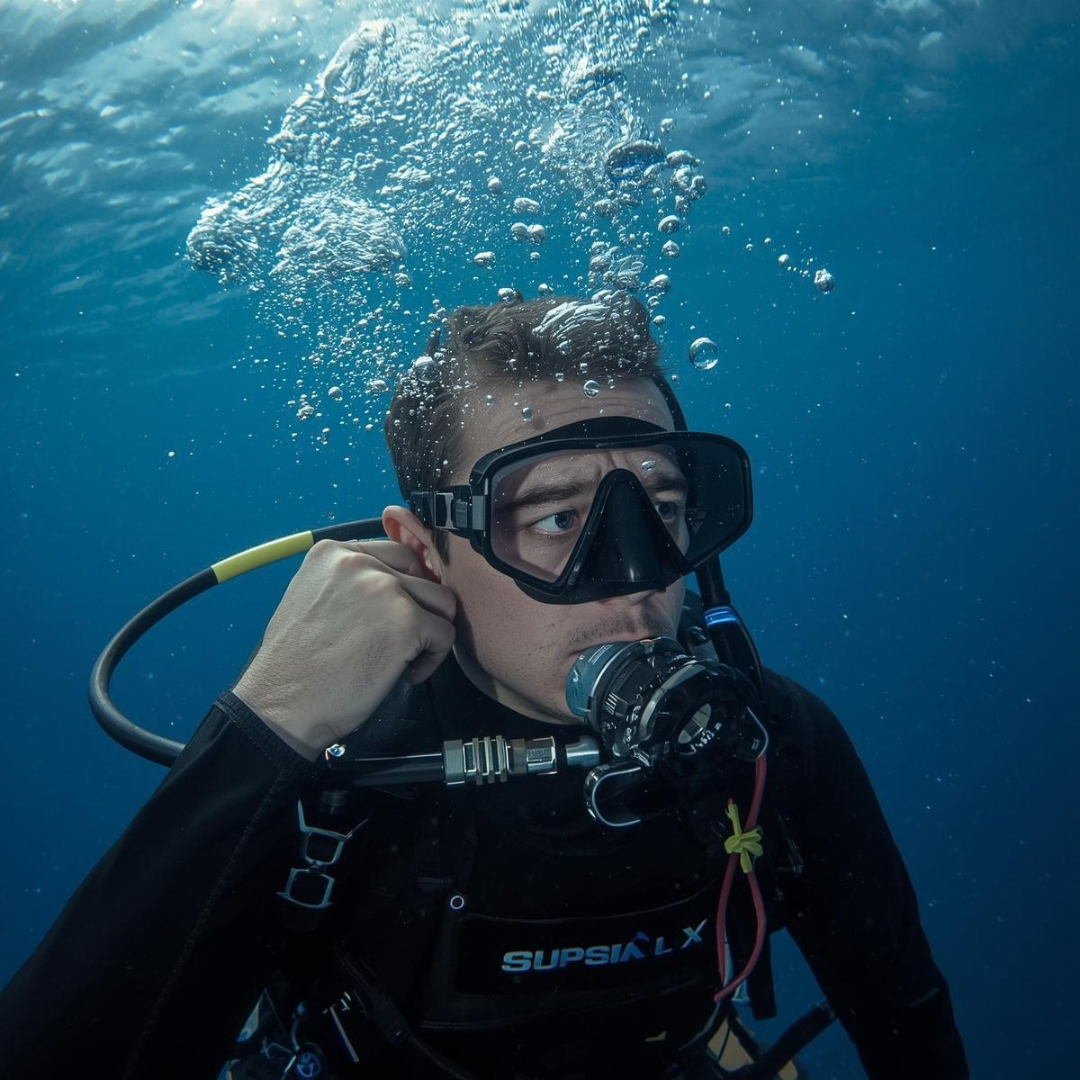
The body has developed a mechanism to maintain equal pressure in the middle ear, and that is the Eustachian tube. The middle ear is a sealed space, but it is connected to the Eustachian tube, which is sometimes open and sometimes closed. This tube can open to equalise small differences in pressure within the middle ear (MUMC+, 2025). When you swallow, yawn or actively push air from your nose into your ears, the Eustachian tube opens, allowing pressure differences to be equalised. This is also known as clearing your ears.
After diving, your ears have experienced significant pressure differences. To clear your ears, you can try swallowing or yawning. Chewing gum and inflating a balloon can sometimes help, allowing air to escape into your middle ear.
A targeted and effective method for this is the use of Otovent, which allows you to introduce air into the middle ear in a controlled manner to normalize the pressure. If the Eustachian tube fails to normalize the large pressure difference after diving, the mucous membranes and blood vessels of the ear become damaged, and this is referred to as barotitis.
If the pressure difference between the outer and middle ear is so great that the eardrum ruptures, this is referred to as barotrauma (S. Cornwell, 2020).

Please note: if the pain persists and is accompanied by hearing loss, dizziness, or discharge, consult a doctor to rule out more serious damage (Symptoms and treatment, 2026).
By practicing equalization techniques, you learn to better protect your ears yourself. It is understandable how frustrating and painful earache after diving can be, which is why you should not wait to take action. This way, you can quickly enjoy your next diving adventure safely and pain free.
If you experience ear pain after diving, it is important to stop diving immediately for the rest of the day and possibly the rest of the week, to avoid further straining your ears (Symptoms and treatment, 2026).
As a beginner diver, you do not need to let this hold you back. It is simply a matter of getting used to it and learning how to equalize your ears properly. Once you have mastered that, you can fully enjoy all your diving adventures again (Symptoms and treatment, 2026).
By being mindful of pressure changes and equalising, diving becomes easier on your ears. Using effective techniques and aids such as Otovent helps to reduce discomfort and support recovery. This way, diving remains enjoyable for everyone.
If you want to know more about diving, such as what you need and where you can dive, it is best to take a look at www.wereldduiken.nl.
There you will find extensive explanations about diving, beautiful dive sites, and blogs specifically for divers.